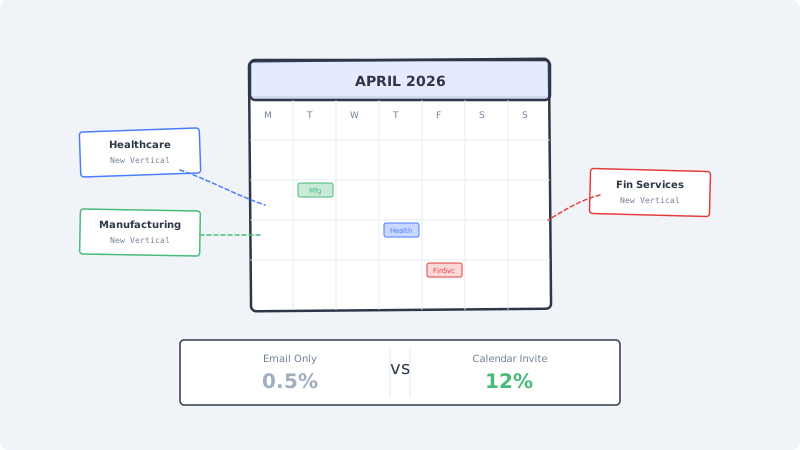
Your outbound engine works in your core vertical. You know the pain points, the buyer personas, the objections, and the competitive landscape. Reply rates are consistent. Meetings convert. Pipeline flows.
Now your CEO wants you to expand into healthcare. Or financial services. Or manufacturing. And suddenly, everything that worked stops working.
Cold email sequences that converted at 4 percent in SaaS produce 0.5 percent in the new vertical. Your messaging does not resonate because you are guessing at pain points instead of speaking from experience. And the decision makers in this new market have different communication preferences, different buying cycles, and different tolerance for unsolicited outreach.
This is where calendar-based outreach changes the equation. Cold calendar invites rise above the cluttered inbox and appear in a space where professionals pay attention: their calendar. When entering a new vertical, this channel advantage matters even more because you do not yet have the brand recognition or social proof to earn opens in a crowded inbox.
Why New Verticals Break Your Cold Email Playbook
Before building a calendar outreach strategy, understand why your existing approach fails in unfamiliar markets.
Your messaging lacks vertical-specific language. Every industry has its own vocabulary for describing problems. Healthcare buyers talk about “patient throughput” and “EHR integration,” not “workflow optimization” and “API connectivity.” When your cold email uses generic SaaS language, it signals that you do not understand the buyer’s world. They delete it without reading past the first sentence.
You have no social proof in the vertical. Your SaaS case studies mean nothing to a VP of Operations at a manufacturing company. They want to see results from companies like theirs, with similar constraints and regulatory requirements. Without vertical-specific proof points, your credibility starts at zero.
Decision-making structures differ by industry. In SaaS, you can often reach the budget holder directly. In healthcare, procurement involves compliance officers, department heads, and sometimes committee reviews. In financial services, legal and compliance must sign off before any vendor conversation happens. Your outreach needs to account for these structures.
Email filtering is more aggressive in regulated industries. Healthcare and financial services companies often run stricter email security policies. Unsolicited emails from unknown senders get quarantined at higher rates. Calendar invites, which travel through a different protocol (CalDAV/iCal), face fewer of these barriers.
The Calendar Invite Advantage for Vertical Expansion
Cold calendar invites solve several problems simultaneously when you are entering a new market.
They demand a decision. An email can be ignored indefinitely. A calendar invite sits on the recipient’s calendar until they accept, decline, or delete it. This forces engagement, even if the engagement is a decline. And declines with comments (“not the right person, try Jane in procurement”) give you intelligence that a silent email never would.
They signal respect for the buyer’s time. A 15-minute calendar invite that includes a clear agenda shows that you are organized and value the prospect’s time. In industries where meetings are carefully guarded (consulting, legal, medicine), this format aligns with how professionals already operate.
They cut through inbox competition. Your prospects in a new vertical are already getting cold emails from competitors who entered the market before you. Calendar invites arrive in a different channel. You are not competing with 50 other sales emails in the morning inbox; you are the only cold outreach on their calendar for that day.
They create urgency through specificity. An email that says “I would love to chat sometime” is easy to defer. A calendar invite for “Tuesday at 2:00 PM: 15-minute intro on reducing equipment downtime at [Company]” is specific enough that the prospect evaluates it against their actual schedule rather than filing it in their mental “maybe later” folder.
Building Your Vertical Entry Playbook
Here is the step-by-step approach for using Kali to break into a new industry vertical.
Step 1: Map the Vertical Before You Prospect
Spend two weeks researching before you send a single invite. This research phase is the difference between sounding like an outsider and sounding like someone who understands the industry.
Identify the top 5 pain points. Read industry publications, join relevant LinkedIn groups, attend one or two webinars, and search for common complaints in forums and review sites. You need to articulate problems in the language the industry uses, not your language.
Map the buying committee. For each target company size, understand who is involved in purchasing decisions. In your new vertical, the person who feels the pain may not be the person who signs the contract. Your calendar invite needs to reach the right person, not just any person.
Study competitor positioning in the vertical. If competitors are already selling to this industry, study how they position themselves. Use CAM to track competitor messaging changes, new landing pages targeting the vertical, and any case studies they publish. This intelligence helps you differentiate your outreach from what prospects are already hearing.
Build a vertical-specific contact list. Source 200 to 300 contacts in your target vertical. Do not go broader yet. These contacts need verified email addresses because calendar invites are sent via email. Run the list through email validation, paying special attention to catch-all domains which are common in enterprise companies. Scrubby can resolve catch-all addresses so you know which contacts will actually receive your invite versus which are phantom mailboxes.
Step 2: Craft Vertical-Specific Calendar Invites
Generic invites fail. Every element of your calendar invite needs to demonstrate vertical awareness.
The invite title should reference an industry-specific outcome. Do not use “Quick intro call” or “Learn about [Your Product].” Instead, use titles like:
- “15 min: Reducing claim processing time at [Company]” (insurance)
- “15 min: Cutting equipment downtime costs at [Company]” (manufacturing)
- “15 min: Streamlining patient intake at [Company]” (healthcare)
The title should make the prospect think “this person knows what I deal with” within two seconds.
The description should lead with their problem, not your product. Write three to four sentences maximum in the invite description. Open with a specific challenge their industry faces. Reference a metric or benchmark if possible. Close with what the 15 minutes will cover, not a feature dump.
Example for manufacturing:
“Unplanned downtime costs manufacturers an average of $260,000 per hour according to Aberdeen Research. We are working with three mid-size manufacturers on predictive maintenance workflows that have reduced unplanned stops by 30 to 40 percent. In 15 minutes, I can walk through how the approach applies to [Company]‘s production environment.”
Set the invite for 10 to 14 days out. Not tomorrow (too aggressive), not next month (too easy to forget). The sweet spot for cold calendar invites is 10 to 14 calendar days from send date, ideally on a Tuesday, Wednesday, or Thursday between 10 AM and 2 PM in the prospect’s time zone.
Step 3: Build a Multi-Touch Sequence Around the Invite
A standalone calendar invite converts at 5 to 8 percent acceptance. Adding touches before and after the invite pushes acceptance rates to 12 to 18 percent in established verticals and 8 to 12 percent in new ones.
Day 1: Send the calendar invite. This is your primary touch. It should be polished and complete.
Day 3: Send a brief email referencing the invite. Keep it under four sentences. Mention that you sent a calendar invite, restate the value proposition in one line, and include one piece of vertical-specific social proof (even if it is a general metric rather than a named customer).
Day 7: Send a LinkedIn connection request with a note. If the prospect has not responded to the invite, connect on LinkedIn with a one-sentence note referencing the same topic. Do not pitch in the connection request. Just establish the touchpoint.
Day 10: Update the calendar invite if no response. Modify the invite with a fresh note in the description. Something like “Updated with a case study link in case helpful” along with an actual relevant resource. This surfaces the invite again in their notification stream.
Step 4: Track Acceptance Rates by Vertical and Adjust
The most valuable data from your vertical expansion is not just whether invites get accepted, but the patterns behind acceptances and declines.
Track acceptance rate by industry sub-segment. You may find that mid-size manufacturers accept at 14 percent while enterprise manufacturers accept at 3 percent. This tells you where to concentrate.
Track acceptance rate by job title. Directors of Operations may accept at 15 percent while VPs accept at 5 percent. This refines your contact targeting for the next batch.
Track decline reasons. When prospects decline with a note (“not the right person,” “we handle this internally,” “talk to our IT team”), that is free market research. Aggregate these signals to refine your ICP and messaging.
Compare calendar outreach to email-only results. Run a controlled test where half your target list gets calendar invites and half gets email sequences only. Measure meetings booked per 100 contacts for each approach. In most new vertical entries, calendar outreach outperforms email by 2 to 3x.
Step 5: Scale What Converts
After 60 to 90 days of testing across your 200 to 300 initial contacts, you should have enough data to make scaling decisions.
Double down on responsive sub-segments. If mid-market healthcare practices accept at 12 percent but large hospital systems accept at 2 percent, scale your list building for mid-market practices.
Refine messaging based on accepted invites. Look at which invite titles and descriptions produced the highest acceptance rates. Build your next 500 contacts’ invites around those proven formats.
Build vertical-specific case studies from early wins. Every meeting booked in the new vertical is a potential case study or quote. Even if the deal does not close, the prospect’s willingness to take the meeting and their feedback on your product’s fit generates social proof for the next wave of outreach.
Avoiding Common Vertical Expansion Mistakes
Do not copy your existing vertical’s playbook word for word. The cadence, channel mix, and messaging that work in SaaS will not transfer directly to manufacturing or healthcare. Treat each vertical as a new market requiring its own testing cycle.
Do not skip the research phase. Two weeks of research saves two months of wasted outreach. Every day you spend learning the vertical’s language, pain points, and buying process compounds into higher conversion rates.
Do not send calendar invites without verified emails. A calendar invite sent to an invalid address bounces harder than an email because calendar systems handle delivery errors differently. Always verify your list before launching invites.
Do not give up after 100 contacts. New vertical entry requires patience. Your first 100 invites are learning, not pipeline generation. Expect lower acceptance rates initially and plan for the conversion rate to improve as you refine messaging through iterations.
Calendar Outreach Makes Vertical Expansion Viable
Breaking into a new vertical with cold email alone requires massive volume to overcome low resonance and zero brand recognition. Calendar invites change the math by delivering your message in a channel where attention is higher and competition is lower.
Start with 200 contacts, send well-researched invites, track every signal, and iterate. Within 90 days, you will know whether the vertical is viable and have the playbook to scale it. That is a faster, cheaper answer than any other expansion strategy delivers.