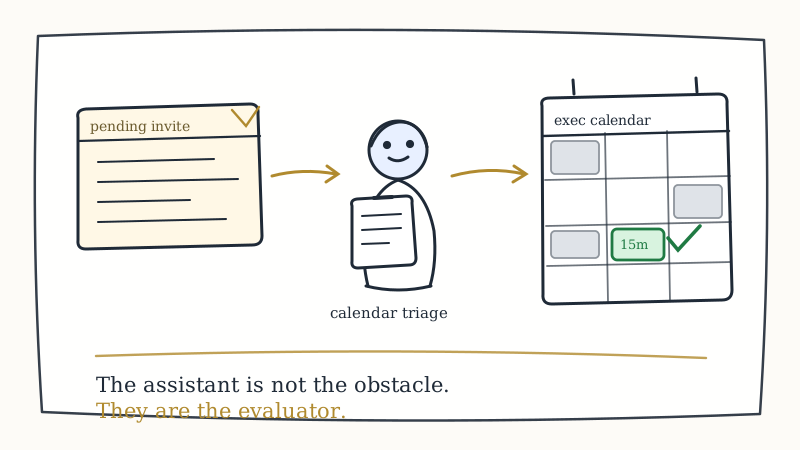
Every outbound playbook written in the last twenty years treats the executive assistant as an obstacle. Get past the gatekeeper. Beat the gatekeeper. Call at 7:30am before the gatekeeper arrives. The entire framing assumes the EA exists to stop you.
That framing was built for the phone. It does not transfer to calendar invite outreach, and if you carry it over you will lose meetings you should have won.
Here is why. When you cold call a VP of Operations, the EA is screening an interruption. Their job in that moment is to protect focus time, and the correct answer to almost every unknown caller is no. But when you send a cold calendar invite to that same VP, the EA is not screening an interruption. They are doing calendar triage, which is a completely different task with a completely different default. Their job is to decide what belongs on the calendar and what does not, and that decision gets made against the exec’s actual priorities, not against a gut read on whether a stranger sounds annoying.
The EA doing calendar triage is not looking for reasons to say no. They are looking for enough information to make a call. That is a far better position to be in than the phone screen, and almost nobody writes invites that take advantage of it.
First, understand what calendar delegation actually looks like
Before you can write for the EA, you need to know whether there is one in the loop and what they can see.
In both Google Workspace and Microsoft 365, an exec can grant another user delegated access to their calendar. The permission levels matter enormously for outbound:
Free/busy only. The delegate sees blocks of time but no event titles or descriptions. Rare for a real EA relationship, common for broad org-wide defaults.
See all event details. The delegate sees your invite title, your description, the attendee list, everything. They cannot respond on the exec’s behalf.
Make changes to events. The delegate can accept, decline, tentatively accept, reschedule, and delete. This is the standard setup for a senior exec with a dedicated EA.
Make changes and manage sharing. Full control, including granting access to others. Usually reserved for chief of staff level relationships.
When the permission is at “make changes” or above, something important happens on the technical side: the response that comes back to you may be sent by the delegate but recorded against the exec. In Google Calendar you will often see the response attributed with a note that the assistant responded on behalf of the organizer’s invitee. In Outlook, delegate responses typically arrive from the delegate’s mailbox with the exec named in the body. Either way, the acceptance is real and the meeting is on the exec’s calendar. The EA accepting is not a soft yes. It is the yes.
That is the first thing most teams get wrong. They see an assistant’s name on the response and treat the booking as low quality. In the enterprise segment it is frequently the opposite: an EA accepting means the invite cleared a deliberate review that no cold email ever gets.
Why the invite beats the email in front of an EA
An EA’s inbox and an exec’s inbox are two of the most hostile destinations in B2B. A senior EA is triaging hundreds of messages a day on behalf of someone whose attention is the scarcest resource in the company. Cold email into that environment is close to hopeless, which is a big part of why reply rates have collapsed below two percent across the board.
The calendar is a different surface with different rules.
It arrives in a queue that must be cleared. An email can sit unread forever with no consequence. A pending invite on a managed calendar is an open item. The EA’s entire function is to leave no ambiguity on that calendar, so every pending invite gets a decision. This is the core mechanic behind cold calendar invite outreach: the invite stays visible and actionable even when the email notification goes unread, and acceptance is a single click rather than a reply-and-negotiate thread.
It is pre-resolved. The hardest part of booking an exec meeting is the scheduling negotiation. An EA who likes your pitch over email still has to find a slot, propose it, wait, and confirm. An invite has already proposed the slot. If it fits, they accept. You removed the step that kills most warm interest.
It is specific, and specificity is what EAs evaluate on. “Quick chat about your infrastructure” is an email subject line. “15 min: consolidating the three observability tools your eng blog mentioned” is something an EA can map to a known priority. That mapping is the whole decision.
It is short. An EA skimming a calendar queue reads at a glance. A three sentence invite description is a complete artifact at that reading speed. A four paragraph email is not.
The EA triage test: four questions, in order
When an EA looks at an unexpected invite from an unknown sender, they are answering four questions in sequence. If any answer is missing, the invite gets declined or left pending, which decays to the same outcome.
1. Is this legitimate?
Does the sender domain look real? Does the name match a human who exists? Is there a company behind this? An EA will absolutely open a new tab and check. If your sending domain is three weeks old with no website, you fail at question one and nothing else you wrote matters.
This is where sending infrastructure stops being a technical nicety and becomes a qualification gate. Proper authentication, warmed sending accounts, and a sender identity that resolves to a real company are the price of entry for enterprise calendar outreach. If your calendar outreach setup cannot clear this bar, the EA segment is closed to you entirely.
2. Is this relevant to something my exec actually cares about?
The EA knows the exec’s current priorities better than anyone except the exec. They know there is a platform migration happening, they know headcount is frozen, they know the board asked about retention costs last month.
Your invite either connects to one of those or it does not. Generic category pitches (“we help companies like yours with sales efficiency”) do not connect to anything. A specific observation about a specific thing the company is visibly doing connects immediately.
This is why signal-driven targeting matters more here than anywhere else in outbound. An invite personalized from a real buying signal (a role change, a funding event, a job posting that reveals a stack decision, a timing trigger) gives the EA the exact bridge they need between you and the exec’s priority list.
3. Does the time work, and if not, is there an obvious alternative?
This one is mechanical and it is where a lot of otherwise good invites die. If you propose Tuesday at 10am and the exec has a standing leadership meeting Tuesdays at 10, you get a decline, not a counter-proposal, unless you made countering easy.
Two things fix this:
Check free/busy where you can. If the exec’s calendar is org-visible or partially shared, propose into actual white space. This is unglamorous and it meaningfully raises acceptance.
Put the flexibility in writing. One line in the description is enough: “If this slot is wrong, propose any time and I will take it.” That converts a mechanical decline into a reschedule, and a reschedule is a booked meeting.
4. What happens if I get this wrong?
This is the question nobody writes for, and it is the one that actually governs EA behavior.
An EA who books a bad meeting has wasted their exec’s time, which is the one unforgivable error in that role. An EA who declines a good meeting has cost the exec an opportunity they will probably never hear about. The asymmetry is brutal and it pushes hard toward declining.
You lower the stakes of a yes by making the commitment small, the agenda explicit, and the exit easy. Fifteen minutes with three bullets of agenda and a plain “if it is not useful in the first five minutes, drop and I will not follow up” is a low risk yes. Thirty minutes labeled “discovery call” with no agenda is a high risk yes. The content of your offer may be identical. The risk profile the EA reads is not.
Writing the invite so it survives triage
Concrete structure. Every element here maps to one of the four questions.
Title. Lead with duration, then the specific subject. Fifty characters or less, because a calendar grid truncates. “15 min: Q1 warehouse automation rollout” works. “Intro call” does not.
First line of the description. State who you are and why you are on this calendar. No preamble, no “hope this finds you well.” The EA is reading one line before deciding whether to read two.
Second line. The specific, verifiable observation that connects to an exec priority. This is the relevance proof and it is the hardest line to write. It should be something you could not have written about any other company.
Third line. The agenda. Two or three bullets, each one a question you will answer or a thing you will show. Not “learn about your needs.”
Fourth line. The flexibility clause and the exit clause. “Any other time works, just propose it. If this is not relevant, declining is a completely fine answer and I will not re-invite.”
That last clause makes people nervous and it should not. Permission to decline raises acceptance rates because it removes the sense that saying yes is the only way to make the sender go away. The EA who feels cornered declines. The EA who feels respected makes the honest call, and the honest call is a yes more often than you would think.
Attendee list. Keep it tight. If delegation is active the EA will see the list. An invite with the exec plus two of their directs reads as a sales play. An invite with just the exec reads as a conversation.
Multi-threading when there is an EA in the loop
A standard enterprise motion involves getting several people from the same account into the same orbit. That still applies, but EA delegation changes the sequencing.
If you invite the exec and three of their reports separately within the same week, the EA may see all four invites, because EAs frequently have visibility across the leadership team’s calendars. Four near-identical invites from the same sender in one week reads as a spray, and it damages you with the one person whose read of you matters most.
Sequence instead. Start a layer below the exec, where there is usually no delegation and the person manages their own calendar. Book that meeting. Then invite the exec with a description that references the first conversation by name: “spoke with Priya on your platform team last Thursday about the migration timeline, she suggested fifteen minutes with you on the budgeting side.” That invite is no longer cold. It carries internal validation, which is the single strongest input to an EA’s relevance judgment. The same multi-threading principle applies, just ordered bottom-up rather than top-down.
Responses you will actually get, and what to do with each
The delegate accepts. Treat it as a confirmed meeting. Do not email the exec to “double confirm” and do not treat it as tentative. Do send a show-up reminder before the meeting, because an EA-booked meeting is a slot on a very full calendar and reminders are what keep attendance from eroding. Managed invite campaigns handle this automatically; if you are running it yourself, put it in your sequence.
The delegate declines with a reason. This is the most valuable response in the entire motion. “Not a priority this quarter” tells you to come back in ninety days. “We just signed with a vendor in this space” tells you to log it and stop. “Wrong person, this would sit with our Director of Supply Chain” is a free referral. Record every one of these as structured data, not as a lost touch.
The delegate replies asking for information. Treat this as the meeting being half booked. Answer in three sentences and re-propose. Do not send a deck. The EA is doing relevance verification on the exec’s behalf, and a long reply reads as evasion.
Tentative acceptance. Means it fits but has not been confirmed with the exec. Leave it alone for 48 hours, then send one short note offering to move it. Do not take tentative as a yes and do not panic it into a no.
Nothing happens. Pending invites are not neutral on a managed calendar. Silence usually means it is sitting below the triage line, which is a relevance failure rather than an interest failure. One follow-up, re-angled on a different priority, is worth sending. Three are not.
Sending volume and the EA network effect
One final thing specific to this segment. Senior EAs talk to each other. In some industries and in some cities they are an actual professional network with shared channels.
Practically, this means your sender reputation with the EA population is a real asset that compounds or depletes. A rep who sends tight, specific, respectfully framed invites builds a quiet reputation as someone whose meetings are worth taking. A rep who blasts four hundred identical fifteen minute invites a week burns it, and burns it across accounts simultaneously.
That argues for the same discipline that governs the rest of calendar outreach: controlled volume, real personalization, clean infrastructure, and no re-inviting people who declined. The ramp-up and sender reputation management that protects deliverability also protects the human reputation, and in the enterprise segment the human reputation is what you are actually building.
The short version
Stop treating the executive assistant as a gatekeeper to beat. On the calendar, the EA is a qualified evaluator doing a job that email never gets access to, and an invite that answers their four questions (is this real, is this relevant, does the time work, what if I am wrong) converts at rates cold email into the same accounts will never touch.
Write the invite for the EA, not around them. They are the best reader you will get in the whole enterprise segment.
If you want this motion run for you, KALI is a managed cold calendar invite outreach service: you provide the target list, KALI personalizes and delivers the invites, handles follow-ups and show-up reminders, and reports acceptance and attendance in real time. See how it works or pricing.