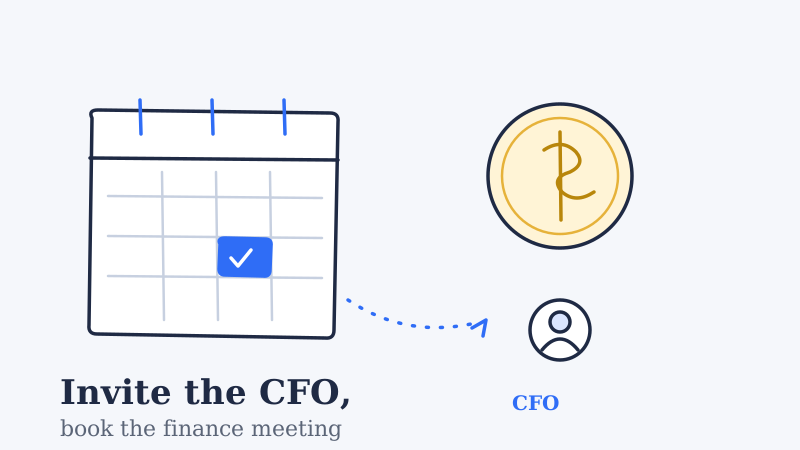
Selling fintech is selling to the most skeptical buyer in the building. A CFO, a VP of finance, a controller, or a head of treasury spends the entire day protecting the company from risk, and the pitch in their inbox is one more thing that might waste time, cost money, or break a process that currently works. That is a hard audience to open, and the standard cold email playbook makes it harder. Finance leaders were the first buyers to install strict inbox filters, delegate their calendar to an executive assistant, and archive anything that reads like a template.
If you sell payments infrastructure, spend management, accounts payable automation, treasury software, embedded finance, or any tool that touches the money, you already know the pattern. Your open rates look fine, your reply rates are near zero, and the meetings you do book came from warm intros or events, not from cold outbound. The channel is not the problem. Email is just the wrong surface for a buyer this guarded.
Cold calendar invites flip the interaction. Instead of asking a finance leader to read a pitch and write back, you propose a specific short meeting at a specific time, and it lands as a pending event on their calendar. This piece covers why that fits fintech selling unusually well, and how to run it without tripping the exact risk alarms your buyer is paid to watch for.
Why finance buyers respond to a calendar hold when they ignore email
A cold email asks for a decision that has no deadline attached, so it slides to the bottom of a queue that never empties. A calendar invite arrives on a different surface. It shows up as a pending event, and most calendar clients also drop a notification into the inbox, so the finance leader has to make a small choice: accept, decline, or propose a new time. That small forced choice is the entire mechanic, and it is exactly what a cold email never produces.
Three things about fintech buyers make this channel fit especially well.
First, finance leaders live inside their calendar. A CFO’s day is a wall of back to back blocks: board prep, close, forecasting, vendor reviews, one on ones. The calendar is the tool they actually trust and check, far more than a marketing email. Landing your request where they already spend their attention beats landing it where they have trained themselves to skim.
Second, the ask is small and concrete. You are not asking for a commitment, a budget, or a signature. You are asking for fifteen minutes. Finance leaders respect a request that respects their time, and a tightly scoped calendar hold reads as far more considerate than a three paragraph email that buries the ask under a value proposition.
Third, the specificity signals seriousness. Anyone can spray a thousand cold emails. Holding a real slot on a named finance leader’s calendar, at a time you clearly chose, reads like someone who did the work. That impression matters more with a risk averse buyer than with almost any other persona. A calendar invite outreach tool like Kali is built to send these as targeted, one to one holds rather than a mass blast, which is the only way this works with a buyer who will notice the difference immediately.
Step one: earn the meeting with a finance specific reason
The fastest way to burn this channel with a CFO is to send an invite with a vague reason, or no reason at all. A pending meeting from a vendor they have never heard of, titled “quick chat,” is worse than a cold email, because it feels like someone put something on their calendar without permission. Finance leaders notice that instantly, and they will decline, mark it spam, or quietly flag your domain.
Every invite has to carry a reason that a finance leader would actually care about, phrased in their language, not yours. Not “learn how our platform can help your team.” More like “fifteen minutes on cutting days sales outstanding without adding headcount,” or “a look at where mid market treasury teams are losing yield on idle cash right now.” The reason should tie to a metric a finance leader is measured on: DSO, close time, cost per invoice, fraud loss, interest income, audit readiness. When the reason maps to a number they already track, the meeting request stops looking like a pitch and starts looking like a peer who understands their world.
This also means your targeting has to be tight. A finance leader at a two hundred person SaaS company has different pains than a treasurer at a manufacturer with global cash positions. Segment your list by the pain your product actually solves, and write the invite reason for that segment. Precision is not optional with this buyer, because a mismatched reason is a signal that you did not do your homework, and a finance leader will hold that against you.
Step two: protect deliverability before you send a single invite
Cold calendar invites depend on the same sending infrastructure as cold email, which means they carry the same deliverability risk. If your invites bounce, land on the wrong calendar, or get flagged, you damage the sender reputation of the domain you rely on for every other finance leader you want to reach. With a buyer this hard to reach, you cannot afford to poison the channel.
The most common failure is a bad address. A lot of finance contact data is stale, generic, or role based, and an invite sent to an inbox nobody with signing authority checks is a wasted touch that still costs you reputation if it bounces. Before you send anything, validate the list. Running your finance leader addresses through an email verification tool like Scrubby first catches the dead and risky addresses so your invites reach real calendars instead of bouncing. A clean list is the difference between a channel that compounds and one that gets your domain flagged after a week.
Beyond validation, keep your sending volume deliberately low and human. This is not a channel for ten thousand sends a week. A rep working a focused list of a few hundred named finance leaders, sending a modest number of well reasoned invites per day, will book more meetings and burn far less reputation than someone treating calendar invites like a spray campaign. The whole advantage of this channel is that it feels personal, and volume is the fastest way to erase that.
Step three: write the invite so a skeptical buyer accepts
The invite itself has three parts that matter: the title, the time, and the description. Finance leaders read all three before they decide.
The title is your subject line, and it should name the outcome, not your product. “15 min: reducing invoice processing cost” beats “Intro to [Company].” Keep it short enough to read fully on a phone notification, because that is where most finance leaders will first see it.
The time signals whether you respect their schedule. Pick a slot that is plausible for a busy executive, mid morning or early afternoon on a Tuesday, Wednesday, or Thursday, and avoid Monday mornings and Friday afternoons entirely. Offer a genuinely short duration. Fifteen minutes is easier to accept than thirty, and once you are in the room you can earn the longer follow up.
The description is where you close the gap between a stranger and an accepted meeting. Two or three sentences: who you are, the specific finance outcome you want to discuss, and one concrete proof point that a finance leader would find credible, a comparable customer, a hard number, a relevant benchmark. Then make declining and rescheduling easy, because a buyer who trusts that saying no is frictionless is more willing to say yes.
If the first invite goes unanswered, the follow up is not a nag. It is a short, polite second touch that offers a new time or a new angle on the same outcome. Finance leaders are busy, not hostile, and a well timed second invite often lands simply because the first one arrived during close week. Treat non response as a scheduling problem, not a rejection, and space your follow ups a week or more apart so you never read as pushy to a buyer who values restraint.
What good looks like
A fintech rep running this channel well is not sending more, they are sending sharper. A curated list of finance leaders whose pain matches the product. A validated set of addresses that protects the sending domain. Invites with titles that name a finance outcome, times that respect an executive calendar, and descriptions that give a skeptical buyer one reason to say yes. Follow ups that read as helpful rather than desperate.
Done that way, cold calendar invites do something cold email has stopped doing for finance buyers: they get a real meeting on the books. For a persona that filters, delegates, and archives everything that looks like a pitch, landing directly on the calendar with a specific, credible reason is the closest thing to a warm intro that outbound can manufacture. Pair a purpose built sending tool like Kali with a clean, verified list from a service like Scrubby, and the hardest inbox in B2B becomes a channel you can actually rely on.