If you sell ad inventory, sponsorships, media packages, or ad tech, you are pitching the one buyer who gets pitched more than anyone else in B2B. A brand marketer or an agency media planner opens their inbox to a wall of sellers offering reach, impressions, a newsletter placement, a podcast read, a retargeting solution, or a shiny new channel. They have seen every subject line, every “quick question,” and every deck. Cold email as a first touch into media and advertising is close to dead, not because the offer is weak, but because the buyer has industrial-grade defenses against exactly the message you are sending.
The people you need are the marketing manager, the brand lead, the head of paid media, the media buyer at the agency, and the sponsorship decision maker. They live at the center of a storm of vendor outreach, and they have learned to ignore all of it as a survival tactic. Your reply rates are near zero, and the deals you close came from a warm intro, an upfront, or a conference hallway, not from cold outbound. The channel is not broken. Email is just the wrong surface for a buyer who has been trained to tune it out.
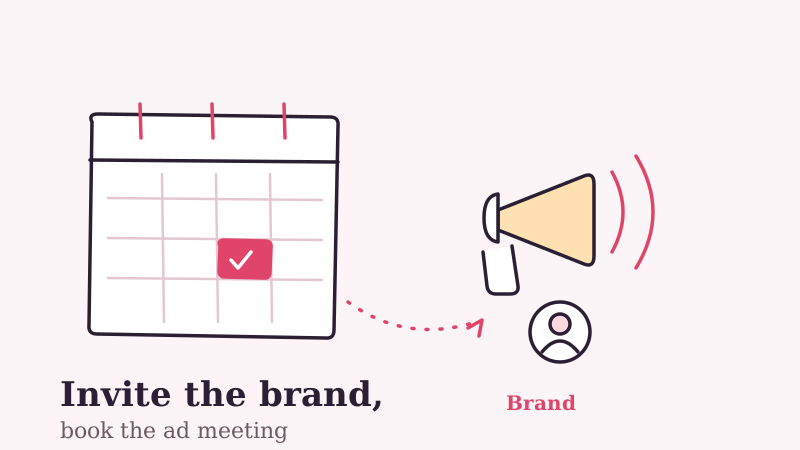
Cold calendar invites change the interaction entirely. Instead of asking a media buyer to read your pitch and write back, you propose a specific short meeting at a specific time, and it lands as a pending event on their calendar. This piece covers why that fits media and advertising selling unusually well, and how to run it without becoming one more thing your buyer swipes away.
Why brand and agency buyers respond to a calendar hold when they ignore email
A cold email asks for a decision with no deadline attached, so it sinks to the bottom of a queue that refills faster than it empties. A calendar invite arrives on a different surface. It shows up as a pending event, and most calendar clients also drop a notification into the inbox, so the buyer has to make a small choice: accept, decline, or propose a new time. That small forced choice is the whole mechanic, and it is exactly what a cold email never produces.
Three things about media and advertising buyers make this channel fit especially well.
First, these buyers run their entire quarter out of their calendar. Campaign launches, flighting windows, agency status calls, creative reviews, and reporting readouts are all scheduled blocks. The calendar is the tool a media planner actually trusts and checks, far more than a marketing email from a vendor. Landing your request where they already spend their attention beats landing it where they have trained themselves to skim and delete.
Second, the ask is small and concrete. You are not asking them to shift budget, sign an insertion order, or greenlight a test. You are asking for fifteen minutes. A media buyer who is protective of a packed schedule respects a request that respects their time, and a tightly scoped calendar hold reads as far more considerate than a three paragraph email that buries the ask under a media kit.
Third, the specificity signals seriousness. Anyone can blast a thousand cold emails offering “premium inventory.” Holding a real slot on a named brand lead’s calendar, at a time you clearly chose, reads like someone who did the work. That impression matters with a buyer who judges vendors on how well they understand the brand. A calendar invite outreach tool like Kali is built to send these as targeted, one to one holds rather than a mass blast, which is the only way this works with a buyer who spots a spray campaign in half a second.
Step one: earn the meeting with a media specific reason
The fastest way to burn this channel with a brand marketer is to send an invite with a vague reason, or no reason at all. A pending meeting from a media vendor they have never heard of, titled “quick chat,” is worse than a cold email, because it feels like someone put something on their calendar without permission. Media buyers notice that instantly, and they will decline, mark it spam, or quietly flag your domain.
Every invite has to carry a reason that a brand or agency buyer would actually care about, phrased in their language, not yours. Not “learn how our platform can help your campaigns.” More like “fifteen minutes on reaching your CTV audience without paying the open-exchange premium,” or “a look at where DTC brands are finding incremental reach this quarter outside of Meta and Google.” The reason should tie to a metric the buyer is measured on: CPM, CPA, reach and frequency, incrementality, brand lift, share of voice, or blended ROAS. When the reason maps to a number they already report on, the meeting request stops looking like a pitch and starts looking like a peer who understands their world.
This also means your targeting has to be tight. A performance marketer at a DTC brand cares about a completely different number than a brand director at a CPG company running an awareness push, or an agency planner assembling a multi-channel buy for a client. Segment your list by the outcome your inventory or product actually delivers, and write the invite reason for that segment. Precision is not optional with this buyer, because a mismatched reason signals that you did not do your homework, and a media buyer who evaluates targeting for a living will hold sloppy targeting against you.
Step two: protect deliverability before you send a single invite
Cold calendar invites depend on the same sending infrastructure as cold email, which means they carry the same deliverability risk. If your invites bounce, land on the wrong calendar, or get flagged, you damage the sender reputation of the domain you rely on for every other brand and agency contact you want to reach. In a market this saturated with vendors, you cannot afford to poison the channel.
The most common failure is a bad address. Marketing and agency contact data ages fast, because these teams reorganize constantly, planners move between agencies, and brand-side marketers change roles every eighteen months. An invite sent to an inbox nobody checks anymore is a wasted touch that still costs you reputation if it bounces. Before you send anything, validate the list. Running your brand and agency addresses through an email verification tool like Scrubby first catches the dead and risky addresses so your invites reach real calendars instead of bouncing. A clean list is the difference between a channel that compounds and one that gets your domain flagged after a week.
Beyond validation, keep your sending volume deliberately low and human. This is not a channel for ten thousand sends a week. A rep working a focused list of a few hundred named brand and agency contacts, sending a modest number of well reasoned invites per day, will book more meetings and burn far less reputation than someone treating calendar invites like a spray campaign. The whole advantage of this channel is that it feels personal, and volume is the fastest way to erase that with a buyer who has seen every mass send there is.
Step three: write the invite so a pitched-out buyer accepts
The invite itself has three parts that matter: the title, the time, and the description. Media buyers read all three before they decide, because reading media is literally their job.
The title is your subject line, and it should name the outcome, not your product or your ad network. “15 min: incremental reach for [Brand] this Q4” beats “Intro to [Media Company].” Keep it short enough to read fully on a phone notification, because that is where most brand and agency buyers will first see it, often between meetings.
The time signals whether you respect their schedule. Pick a slot that is plausible for a busy marketer, mid morning or early afternoon on a Tuesday, Wednesday, or Thursday, and avoid Monday mornings and Friday afternoons entirely. Steer clear of the obvious crunch windows too, like the week a big campaign launches or the end-of-quarter reporting scramble. Offer a genuinely short duration. Fifteen minutes is easier to accept than thirty, and once you are in the room you can earn the longer follow up.
The description is where you close the gap between a stranger and an accepted meeting. Two or three sentences: who you are, the specific media outcome you want to discuss, and one concrete proof point that a marketer would find credible, a comparable brand you moved the number for, a hard performance figure, or a relevant audience benchmark. Then make declining and rescheduling easy, because a buyer who trusts that saying no is frictionless is more willing to say yes.
If the first invite goes unanswered, the follow up is not a nag. It is a short, polite second touch that offers a new time or a new angle on the same outcome. Media buyers are busy, not hostile, and a well timed second invite often lands simply because the first one arrived during a launch week. Treat non response as a scheduling problem, not a rejection, and space your follow ups a week or more apart so you never read as pushy to a buyer who screens vendors for a living. If you want a deeper framework for pacing those touches, our guide to cold calendar invite follow-up sequences breaks down the timing.
Step four: use the meeting to prove you understand the brand
Booking the meeting is the win this channel delivers, but the media and advertising buyer will decide in the first two minutes whether you belong in their consideration set. The invite bought you the room. What you do inside it determines whether the hold turns into a pilot flight, a test budget, or a spot on the media plan.
Come in having done real homework. Know what the brand is running right now, which channels they lean on, who their competitors are outspending them, and where their current mix leaves a gap you can fill. A media buyer can tell within a few sentences whether you looked at their actual campaigns or whether you are reading the same script you use on everyone. Lead with the specific outcome you named in the invite, show the proof point you promised, and ask about their goals for the next flight before you talk about your inventory. The reps who win media budget are the ones who sound like a planner, not a vendor.
The channel fits the media buyer better than any other persona
Every persona is hard to reach cold, but the media and advertising buyer is a special case. They are the single most pitched title in B2B, they screen outreach for a living, and they judge every vendor on precision and relevance because that is exactly what they sell to their own clients. A cold email walks straight into all of those defenses. A cold calendar invite sidesteps them by landing on the one surface this buyer actually trusts, with an ask small enough to accept and specific enough to take seriously.
Run it with tight targeting, a clean and validated list, a media specific reason, low human volume, and a genuinely useful fifteen minutes waiting on the other side. Do that, and you turn the most saturated inbox in B2B into a booked meeting, while the rest of your competitors are still waiting on a reply that is never coming. Tools like Kali exist to make that motion repeatable, so a rep can work a focused book of brands and agencies and put real meetings on the calendar every week.